


How Do Stealth Games Make Hiding Scary?

Updated: 4 days ago
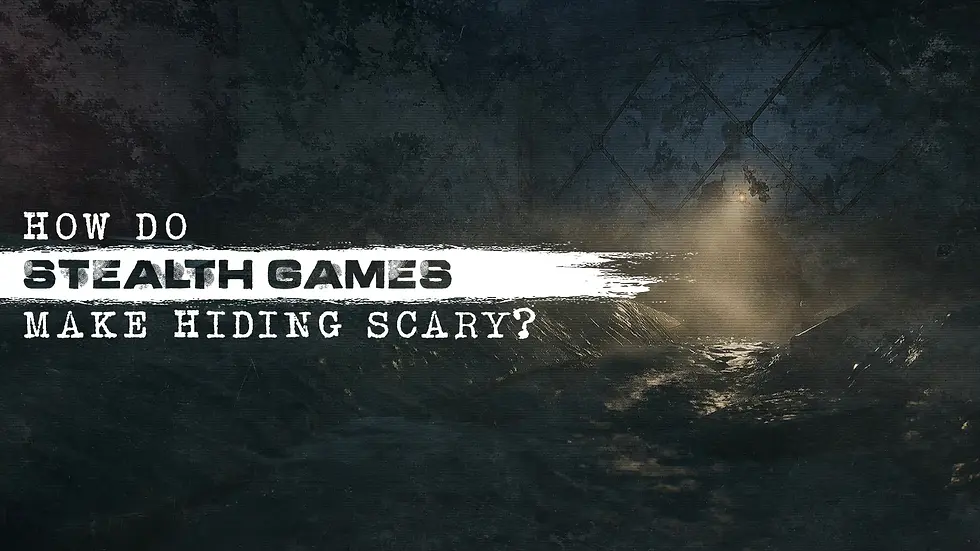
A flashlight clicks off. Somewhere beyond the next doorway, something shifts its weight across a wet floor. You could run, but the hallway is too narrow and the sound would carry. You could fight, but you do not know what is waiting. So you hold still and listen. Can stealth games be scary? Absolutely. In the right hands, hiding from a threat can create a slower, more personal kind of fear than any firefight.
Stealth is not automatically horror. Sneaking past guards in a power fantasy feels very different from slipping through an abandoned farmhouse with a creature searching room by room. The difference is vulnerability. Horror stealth works when the player is not simply avoiding an obstacle. They are surviving an encounter they are not prepared to win.
Why Stealth Games Can Be Scary
The most frightening horror often happens before the danger is fully visible. Stealth gives that waiting room a purpose. A locked door, a dark staircase, or a patrol route becomes tense because the player has time to imagine what could go wrong.
In action games, an enemy is usually information: a target to identify, flank, and eliminate. In survival horror, that same enemy can become a question. Is it alone? Does it hear footsteps? Will it investigate a dropped object? Can it open the door between you and the place you thought was safe?
That uncertainty is where stealth earns its fear. The player is forced to pay attention to sound, sightlines, shadows, and the small signs left in the environment. Fear stops being a cutscene that happens to them. It becomes something they participate in creating.
Hiding Removes the Comfort of Control
A powerful weapon offers reassurance, even when ammunition is limited. It tells the player there is a direct answer to danger. Stealth takes that answer away, or makes it costly enough that it cannot be the first choice.
When hiding is the safer option, the player has to let the threat remain alive and active in the world. They may be crouched beneath a desk, inside a closet, or behind the rusted machinery of an old utility building, listening as footsteps pass close enough to make movement feel impossible. The enemy has control of the space. The player only has a temporary corner of it.
That imbalance matters. It turns a simple mechanic - remain unseen - into a scene of sustained dread. The player is not testing reflexes alone. They are deciding whether to breathe, move, or wait one more second.
Sound Makes Invisible Danger Feel Close
Visual horror is immediate. Sound is invasive. A distant radio crackling through an empty building, branches snapping in a black forest, or a strange signal bleeding through a telephone line can suggest danger before the player sees anything at all.
Stealth games use sound as both warning and pressure. Hearing an enemy approach may help the player survive, but it also forces them to picture the threat. A heavy step tells a different story than a quick scrape across tile. A voice that stops mid-sentence can be worse than a scream.
The strongest audio design does not explain everything. It leaves gaps. If players hear something moving above them but cannot find stairs, the building itself begins to feel untrustworthy. Every ceiling panel and dark vent becomes part of the threat.
Fear Comes From Being Seen
The moment an enemy notices the player is often treated as failure. In effective stealth horror, it is a change in the temperature of the scene.
A searchlight sweeping across a field is frightening because it could land on you. A creature pausing at a door is frightening because it may have heard you. Detection transforms familiar spaces into traps. The route that felt careful and manageable seconds ago now has no safe exit.
This is why enemy behavior matters more than sheer enemy count. A single pursuer with readable but unsettling habits can create more dread than a room full of disposable attackers. The player learns its patterns, then discovers those patterns are not a promise. Perhaps it checks hiding places. Perhaps it reacts to light. Perhaps it disappears when it should be nearby.
There is a trade-off here. If detection is too punishing, stealth becomes frustrating instead of frightening. Repeating the same sequence after an instant failure drains the mystery from a scene. But if escape is always easy, the threat loses its weight. The best balance gives players a narrow chance to recover: break line of sight, create a distraction, use the environment, and live long enough to feel the consequences.
Limited Resources Make Every Choice Feel Dangerous
Stealth becomes especially tense when it shares space with survival systems. A player may have one flare, a nearly dead flashlight battery, a healing item they are saving for later, or a key objective located behind the thing hunting them.
These limits create meaningful hesitation. Do you use a valuable resource now to cross a dangerous area, or risk saving it for a threat you have not met yet? Do you search the locked storage room for supplies, knowing the noise might draw attention? Do you take the short route through the woods, where visibility is low, or the longer road past the abandoned gas station?
The answer should depend on the player, not a single correct solution. Fear grows when survival requires judgment under pressure. The player remembers the decision because it belongs to them.
Environment Is Part of the Stealth System
The best stealth horror spaces are not empty corridors built only for patrol routes. They tell stories while they create risk. A small-town diner after closing time, a sheriff's office with files missing from their cabinets, or a rural radio station humming after midnight can make players curious enough to move forward despite their fear.
That is a crucial tension. Horror needs a reason to enter the next room. Investigation provides it.
Environmental storytelling can also make stealth more unsettling. A trail of muddy footprints leading into a basement tells the player where danger may be, but not whether it is still there. Family photos left scattered in a living room can turn a hiding place into evidence of something gone wrong. The location is no longer background. It is a witness with secrets of its own.
For a sci-fi survival-horror setting, the unknown adds another layer. An extraterrestrial presence does not have to follow familiar rules. Strange lights over a treeline, equipment that fails at the wrong moment, and signals that do not belong on any known frequency can make ordinary spaces feel alien without abandoning the grounded details that make them believable.
When Stealth Stops Being Scary
Not every stealth sequence produces dread. Players quickly lose fear when enemies behave like predictable machines, when hiding spots are too obvious, or when the game repeatedly announces danger before it arrives. A meter filling up on screen can be useful information, but it should not replace atmosphere.
Constant pursuit can also flatten the experience. If a monster is always chasing the player, there is no room for suspicion, investigation, or the uneasy quiet that makes pursuit hit harder later. Silence needs to feel temporary. Safety needs to feel questionable.
Cheap jump scares have a similar limitation. They can startle, but they rarely sustain fear by themselves. Stealth horror is more memorable when a player notices a door that was previously open is now closed, or realizes the sound they have been tracking has stopped. The game does not need to shout. It only needs to make the player question what they thought they understood.
The Kind of Fear That Follows You
Stealth games are scary when avoidance feels like survival rather than routine. They turn darkness into cover and a liability. They make every floorboard, flashlight beam, and half-open door part of a conversation between the player and whatever is nearby.
That is the tension at the heart of Pine Creek: an 80s small-town mystery where investigation, exploration, puzzles, and intense survival mechanics pull players deeper into places they may not be ready to understand. Sometimes the most frightening choice is not to fight the unknown. It is to stay quiet while it passes close enough to hear you breathe.

Comments